
The Kickstarter Pre-Launch Funnel: Three Pages, One Job
Short answer: A Kickstarter pre-launch funnel is three pages, not one: a launching-soon page to capture emails, a VIP page to filter buyers from browsers, and a referral page to multiply.
A single landing page collecting email addresses is where most pre-launches begin and end. It’s also where the money quietly leaks out.
Not because the page is bad. Because one page is being asked to do three different jobs, and it can only do the first one. A proper Kickstarter pre-launch funnel is three pages: one to capture the email, one to work out who’s actually going to pay, and one to turn the people you have into more people. As an official Kickstarter Expert Partner this is the gap I see most often between campaigns that fund on day one and campaigns that don’t.
Why one page can’t do three jobs
Ask a founder how the pre-launch is going and you’ll get a signup count. Two thousand emails. Sounds healthy.
The problem is that a signup costs nothing, so it tells you almost nothing. Someone who liked the look of your product at 11pm and typed an address into a box has not promised you anything and probably won’t remember you in six weeks. Your list becomes a number you plan around, and then day one arrives and 3% of it converts.
What you actually need to know before launch is a different question: how many of these people will put money down? Because that number, times your average pledge, is your funding goal. Set the goal from the signup count and you’ll set it two or three times too high, which is the single most expensive mistake available to you.
One page can’t answer that. It has no mechanism for distinguishing the curious from the committed. So you add a second stage whose entire purpose is to make that distinction.
Stage one: the launching-soon page
The job here is narrow. Capture the email, quickly, from cold traffic.
Product photograph, a headline that says what the thing is, an early-bird line to explain why signing up now beats signing up later, and one field. Readable in twenty seconds. Nothing else on it should compete for attention, which is why I’ve written up the six blocks a pre-launch page needs separately.
One rule that saves real money at this stage: point your paid traffic here, never at your Kickstarter pre-launch page. A follower on Kickstarter belongs to Kickstarter. You can’t email them, segment them or take them anywhere. Capture the address on your own page first, then ask those subscribers to go and hit follow.

Stage two: the VIP page, which is the one that does the work
This is the stage almost nobody builds, and it’s the one that changes your forecast.
After someone signs up, they land on a page with a better offer attached to a small commitment. On the builds I do, that’s a free gift they choose plus guaranteed early-bird pricing, and optionally a small deposit that unlocks super early bird pricing instead. The deposit goes straight into the creator’s own Stripe account, not mine.
The deposit is the interesting part, and it’s optional for a reason. Asking for £1 to £10 raises the friction bar, so fewer people go through. What you get in exchange is a genuine signal. Reservation deposits convert into backers in the region of 20 to 40 percent, against roughly 3 to 10 percent for a cold email list. Someone who put a card in has told you something a free signup never will.
So the trade is fewer names, far better information. If your product is expensive or unusual and you need to know whether the demand is real, take the deposit. If you’re in a category where the audience browses casually and volume matters more, leave it off and use the free-gift version. Either way you’ve now split your list into people who chose to act and people who didn’t, and that distinction is what makes a VIP list convert.
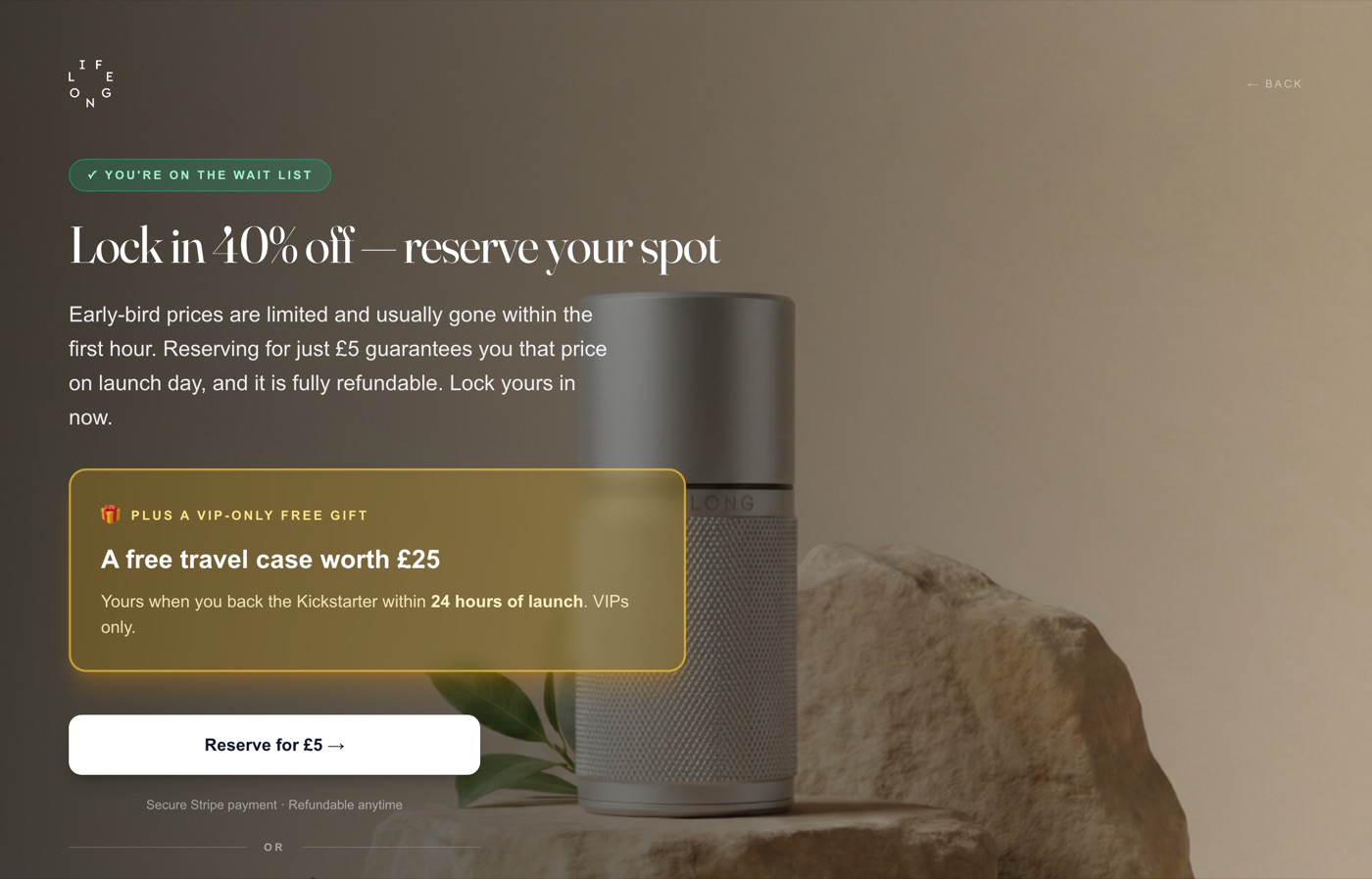
Not sure which version fits your product, or what the deposit should be? That’s a good use of the £60 strategy call before you build anything.
Stage three: the referral page, the multiplier
Once someone is in, they can be worth more than one signup.
The referral page gives an existing subscriber a shareable link and a reward ladder to climb: share with two people and unlock this, five and unlock that. It tracks what their sharing actually produced, so the reward is earned rather than promised.
Two things matter about where this sits. First, it comes after signup, never on it. Asking a stranger to recommend a product they haven’t decided on yet is asking for a favour before you’ve given them a reason. Second, the rewards want to be things that cost you little and feel like status: an upgraded colourway, a name in the credits, an extra accessory. Discounts work but they train people to wait.
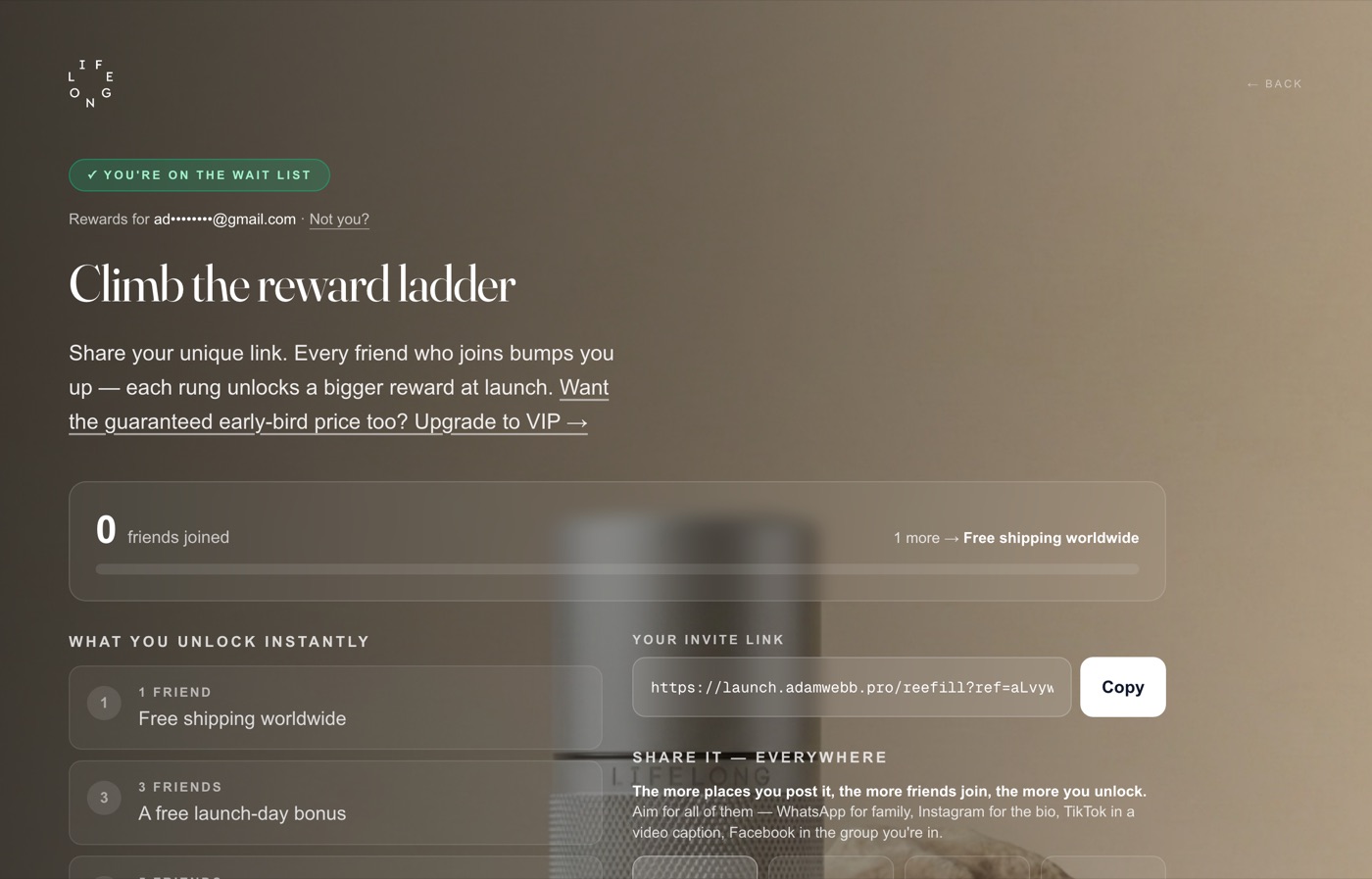
Done properly this is the cheapest traffic in your whole pre-launch, because it comes from people who already like the thing and it costs you nothing per lead. It also compounds, which paid traffic never does.
The maths, and why it isn’t what you’d expect
Worth being precise about what the funnel does, because it’s easy to oversell.
Say you finish pre-launch with 2,000 email addresses and a £60 average pledge. Plan from that number alone and you’re guessing: somewhere between 3 and 10 percent will back on day one, so somewhere between £3,600 and £18,000. That’s not a forecast, it’s a range wide enough to be useless, and founders resolve it by picking the optimistic end and setting the goal there.
Now run the same list through a VIP stage and suppose 180 of them put a deposit down. Those people convert at more like 20 to 40 percent, so that’s 36 to 72 backers from that group, worth £2,160 to £4,320, and you can see them. The other 1,820 still behave like a normal list.
Here’s the part people miss: the funnel has not created a single extra backer. The same humans wanted the same product either way. What changed is that you can now see a floor. You know roughly what day one produces at the pessimistic end, which means you can set a goal you clear in hours rather than one you hope to reach in a month.
That’s the whole value, and it’s worth more than it sounds. Funding fast is what gets you Kickstarter’s own distribution, so a goal set to a number you can actually see is the difference between a campaign that gets surfaced and one that doesn’t. The referral stage is the only part that genuinely adds people, which is why it sits last.
If your VIP numbers come back terrible, that’s not the funnel failing. That’s the funnel working, in week six, while it’s still cheap to change something.
What the three of them buy you
Run all three and you arrive at launch day with something most founders don’t have: a number you believe.
You know how many people signed up, how many of those put money down or claimed a VIP slot, and roughly what each is worth. That gives you a defensible funding goal, which is the thing that lets you fund on day one rather than limp and get picked up by Kickstarter’s own distribution.
It also front-loads the bad news. If two thousand signups produce forty VIPs, that’s painful in week six and survivable. Finding out on day one of a live campaign is neither.
What it costs
I build the three as one job for £200, and it’s included free with the £750 coaching programme, along with your dated launch schedule. Details are on the launching-soon page build.
You can absolutely build this yourself, and if you have the time you should. The reason people hand it over is that it sits on the critical path months before launch and it’s the sort of task that slips behind more interesting work until it’s too late to matter.
Key takeaways
- A pre-launch funnel is three pages: capture, filter, multiply.
- Signup counts flatter you; only the filter stage predicts launch-day behaviour.
- Reservation deposits convert around 20-40% versus 3-10% for cold email.
- The deposit is optional and unlocks super early bird pricing plus a free gift.
- Never point paid traffic at your Kickstarter pre-launch page; capture the email yourself.
- Referral rewards belong on their own page, after signup, never before.
Want a hand with yours?
If you’ve got a landing page collecting emails and no idea how many of those people will actually pay, that’s the gap this fixes, and it’s worth closing before you commit to a funding goal.
The £60 strategy call will tell you which version fits your product. If you’d rather it was just built, the three-page build is £200, or free if you’re on the coaching programme.
Frequently asked questions
What is a Kickstarter pre-launch funnel? +
Three connected pages that do three different jobs. A launching-soon page captures the email, a VIP page separates the people who will actually pay from the people who are curious, and a referral page turns your existing signups into more signups. Most founders build only the first one and call it a pre-launch.
Why not just use one landing page? +
Because a single page collecting emails tells you how many people liked the idea, which is a number that flatters you and predicts nothing. On launch day the only figure that matters is how many will actually pay, and one page can't tell you that. The second stage exists to find out before you set your funding goal.
How much should a VIP deposit be? +
Small enough to be a decision rather than a purchase, so typically £1 to £10. The point isn't the money, it's the signal: someone who puts a card in has told you something a free email never will. On my builds it's optional and the deposit goes straight into the creator's own Stripe account, not mine.
Where do referral rewards fit in a pre-launch? +
On their own page, after someone has signed up. The reward ladder gives an existing subscriber a reason to share and tracks what their sharing produced. Bolting referral onto the signup page rarely works, because you're asking a stranger to recommend something they haven't decided on yet.
Do I need all three pages before I launch? +
You need the first two. A launching-soon page and a way to identify your genuine buyers are what let you set a funding goal you can clear on day one. The referral page is the multiplier and it earns its place once you have a few hundred people to multiply.