
Why Most Kickstarter Campaigns Fail (The Boring Real Reasons)
Short answer: The real reasons Kickstarter campaigns fail have nothing to do with marketing. It's the boring structural stuff nobody wants to hear.

Roughly 40% of Kickstarter campaigns hit their goal. Which sounds bleak until you realise the other 60% mostly failed for the same handful of reasons, and none of them were “bad marketing”. That’s the lazy answer people reach for when the honest one is harder.
I’ve been running Kickstarter campaigns since 2019, and as an official Kickstarter Expert Partner I’ve reviewed a lot of finished campaigns from the outside in. The patterns aren’t glamorous. Nobody wants to write a post titled “Your Reward Tiers Were Priced Wrong” because it doesn’t feel like a story. But it’s the story.
So here’s the boring truth about why most Kickstarter campaigns fail. Not the founder-motivation stuff. The actual structural mistakes.
The lazy answers, briefly
Before the real list, let’s swat the usual suspects.
“Bad marketing.” Sometimes. Mostly no. Marketing amplifies what’s already there. If the underlying campaign is broken, more ad spend just means more people bouncing off a broken page.
“Wrong timing.” Almost never true. There’s no perfect week to launch. Founders who obsess about the calendar usually have bigger problems with their pre-launch signal than with the season.
“The algorithm changed.” Kickstarter’s discovery mechanics have been broadly stable for years. What changed is that more campaigns are now competing for the same spots. The bar went up. The rules didn’t.
“Not enough backers on Kickstarter.” Kickstarter has around 25 million lifetime backers. There are enough backers. Your campaign didn’t reach them because it didn’t earn the algorithmic push.
Right. Now the actual reasons.
1. The pre-launch email list was too small (and too cold)
This is the single biggest predictor of failure I see. Founders launch with 300 email addresses collected six months ago and are shocked when day one is a whisper.
The rough number I aim for: at least 1,000 warm subscribers before launch, ideally 2,000+. And by “warm” I mean people who signed up in the last 60 days and have opened at least one email. Not the 800 people who filled in a landing page in January and forgot who you are.
If you want the actual numbers to hit, I broke down the maths in pre-launch email list size and the 12-week pre-launch timeline. The short version: if your list can’t 30-40% your goal on day one, you’re launching cold.
2. Wrong category, wrong benchmark
Kickstarter’s overall success rate is roughly 40%. But that average hides everything.
Comics: around 66%. Tabletop games: near 60%. Design: mid 40s. Food: low 20s. Technology: depends heavily on sub-category, hardware often below average.
Founders benchmark against “40%” and think they’re aiming at a coin flip. If you’re in food, you’re actually aiming at a 1-in-5 shot unless you’ve done something significantly stronger than most. Know your actual category odds before you pick your goal.
3. The funding goal is set wrong
Two failure modes here, both common.
Set it too high, you don’t hit 100% and Kickstarter refunds everyone. You raised nothing. Set it too low to “guarantee funding”, you hit goal on day two and lose all urgency. The stretch-goal narrative that would have carried you through the middle two weeks never lands.
The honest goal is the minimum number that lets you actually manufacture and ship. Not your aspirational target. That’s what stretch goals are for. If manufacturing needs £40k, don’t set goal at £10k because you’re scared. You’ll hit £15k, celebrate, then realise you can’t actually make the product.
I actually advised on this campaign recently. Told the founder to drop the goal to £30k, negotiate the supplier’s MOQ down, and run proper ad spend from day one. He didn’t do any of it. Working with me he did get Projects We Love and editorial coverage from Kickstarter (the exact signals founders spend months chasing) but the goal was still set too high, the ads never got serious, and now the campaign is stuck at £41k with 29 backers.
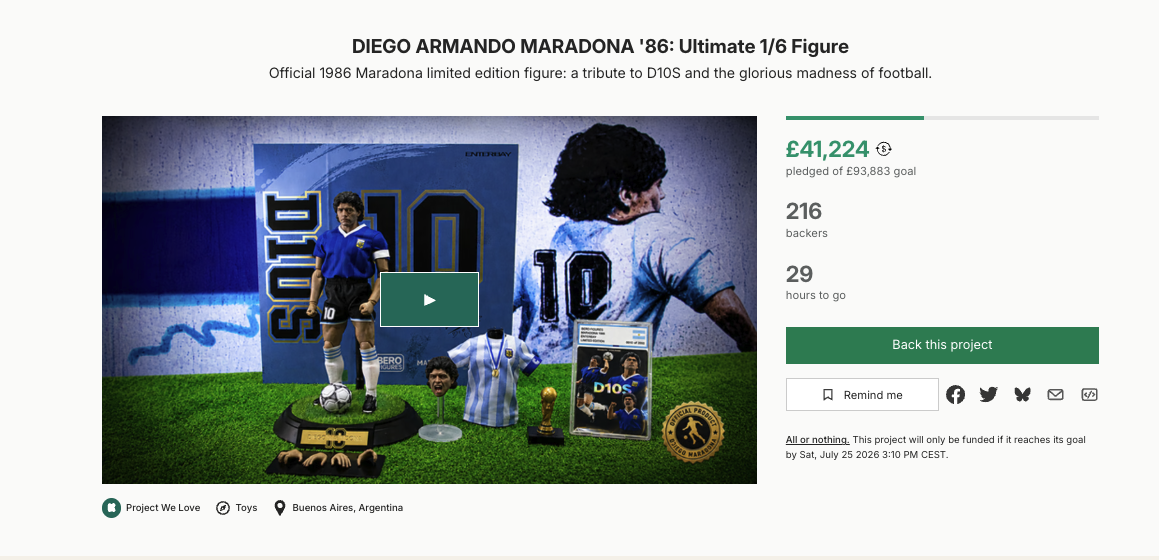 Which is the whole lesson of this post in one paragraph: the biggest algorithmic gifts Kickstarter can hand you don’t save a badly-set goal, and a founder who ignores the tactical advice will fail with or without them.
4. The video doesn’t sell the product in the first 15 seconds
Most Kickstarter videos start with a founder introducing themselves, followed by a soft cello track, followed by a lifestyle montage. By the time the product appears, half the viewers have gone.
Watch your own video with the sound off, from a cold start, on a phone. If you can’t tell what the product is in the first 5 seconds, the video isn’t working. I go deeper in Kickstarter video that converts, but the summary is: product first, story second, founder third. Not the other way round.
5. The page doesn’t answer “what is it” in 3 seconds
Open your live preview on a phone. Look at what’s above the fold. If the first thing a backer sees isn’t a crisp image of the product plus a one-sentence explanation of what it does, the page is failing.
Founders love to write. They put a heartfelt origin story where the product shot should be. They use headings like “Meet the future of X” instead of “A rechargeable Y that lasts 3 weeks”. Backers don’t want to work to figure out what you’re selling. Three seconds. If they can’t answer “what is it”, they’re gone.
6. Reward tiers that don’t anchor
The pricing structure of your tiers isn’t decoration. It’s the single biggest lever on average pledge value.
Most failing campaigns have one tier at £49, one at £99, and a “double pack” at £180. No anchor above. No reason for the £99 backer to consider stretching. I broke down the pricing psychology in reward pricing explained with a calculator, but the short version: you need a high anchor tier priced high enough to make your main tier look sensible. If your main tier is £99, your top anchor should be £499+.
7. Shipping costs quietly kill the campaign
This one’s a slow-motion crash. Founders forget to properly cost shipping, especially international, and end up either hiding the true cost until checkout (which kills conversion) or absorbing it (which kills margins).
Kickstarter shows shipping at pledge time. If your UK-to-EU shipping is £22 on a £49 pledge, backers will notice and bounce. You need to know your fulfilment cost per SKU, per region, before you pick your reward prices. Get this wrong and every pledge loses you money you didn’t know you were losing. Pair your shipping maths with Kickstarter’s own fees. A lot of first-timers under-price rewards because they forgot the platform’s ~10% cut sits on top of shipping, VAT and manufacturing.
8. Launching cold with no warm audience
This is the one that breaks my heart the most. Founder builds the product for two years, hires a videographer, writes beautiful copy, launches, and… nothing. Because they built the product in a vacuum and had no audience waiting.
Kickstarter’s algorithm doesn’t gift you traffic just because your page is pretty. It rewards early velocity. And early velocity comes from a warm audience you’ve built for months before launch. If day one is the first time people hear about your product, you’ve already lost.
9. Treating Kickstarter like a shop
Kickstarter isn’t a shop. It’s a story with a deadline.
Founders who copy their Shopify page onto Kickstarter miss the entire point. There’s no “buy now, receive tomorrow” here. Backers are pledging to a promise. That means the campaign needs urgency (30 days, then it’s gone), community (updates, comments, live streams), and stretch (goals to unlock as it grows). Strip those out and you’ve got an expensive pre-order page with an all-or-nothing catch. And if you’re mid-way through pre-launch quietly wondering whether Kickstarter is even the right platform for you, don’t ignore that voice. I broke down the trade-offs in Kickstarter vs Indiegogo in 2026, because platform choice is a failure mode people forget about until it’s too late.
10. Underestimating what marketing costs
Since we’re on it: even a well-built campaign usually needs paid support. Meta ads are the standard, and the budget most founders come to me with is roughly a third of what they’ll actually need.
The rough number: expect to spend 20-30% of your funding goal on ads to fully hit it. I walked through the maths in Meta ads budget for Kickstarter. Founders who launch with “we’ll see how it goes” on ads almost always plateau at 30-50% of goal.
If any of these sound like a mirror, my strategy call is the fastest way to find out which ones apply to you before you spend money launching a campaign that won’t work.
The pattern I see in every failed campaign I review
When I get asked to look at a campaign that flopped, the founder almost always thinks the failure was marketing. It’s almost never marketing.
It’s this: the campaign launched without a warm audience, so day one was flat. Because day one was flat, the algorithm didn’t push it. Because the algorithm didn’t push it, ad costs stayed high and organic backers stayed low. By day 5 the campaign was at 20% of goal and everyone knew it wouldn’t hit. The last three weeks were watching a slow deflation.
The failure happened months before launch. In the empty pre-launch list. In the goal set to please investors rather than reflect reality. In the video shot in a hurry. In the page written in one afternoon.
Fixing a failing campaign mid-flight is almost impossible. Preventing one from failing is quite possible. That’s the whole game. If you want a longer version of this, I catalogued the 30 expensive Kickstarter mistakes I see most often. Read that too.
Want a hand with yours?
If you’re pre-launch and any of the above made you wince, that’s the point. Better to wince now than to watch it play out live for 30 days.
I offer a £60 strategy call where I look at your product, your list, your goal, and your reward structure and tell you honestly whether you’re ready. If you’re not, I’ll tell you what to fix before you spend money launching. If you are, I’ll tell you that too and get out of your way.
Either way, you’ll have a clearer picture in an hour than you’ll get from six weeks of Googling.
Frequently asked questions
What percentage of Kickstarter campaigns fail? +
Kickstarter's own reported success rate sits around 40 to 43%, meaning roughly 6 in 10 campaigns don't hit their funding goal. That number has been broadly stable for years. It varies wildly by category though. Comics and tabletop games are up around 60 to 66%, while food and technology accessories sit well below the average.
Is bad marketing the main reason Kickstarter campaigns fail? +
No, and this is the lazy answer that lets everyone off the hook. Most failed campaigns had structural problems long before an ad was ever run. Weak pre-launch list, a page that doesn't explain the product in three seconds, a video that talks about the founder instead of the product. Marketing amplifies whatever's already there. If the underlying campaign is weak, more traffic just means more people bouncing.
How much do failed Kickstarter campaigns usually miss by? +
In my experience reviewing them, most failed campaigns don't miss by 5 or 10%. They miss by 60% or more. That's the tell. A campaign that reaches 40% of goal wasn't a marketing miss, it was a signal problem from day one. The pre-launch list was too small, too cold, or both.
Can a failed Kickstarter campaign be rescued? +
Rarely, and almost never once the first 48 hours are gone. Kickstarter's algorithm pushes campaigns with strong opening velocity onto Popular, Projects We Love, and the discovery feeds. Miss that window and you're spending the rest of the campaign trying to buy attention Kickstarter would have given you for free. The honest answer is usually: cancel, learn, relaunch clean.